
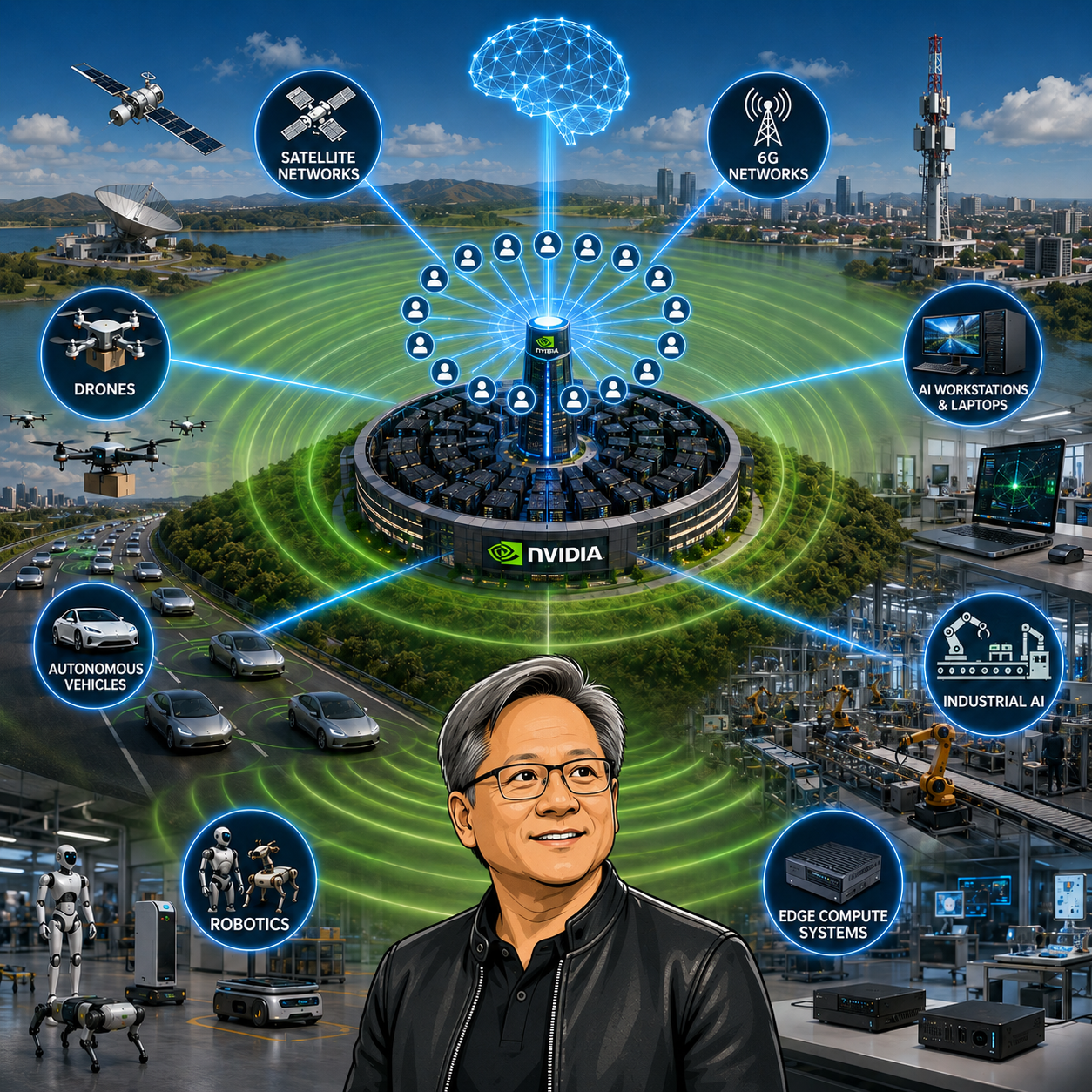
NVIDIA hopes physical AI and edge AI will spread this agentic demand wave farther out, as AI agents help to automate and streamline operations across every industry. NVIDIA wants to spread its entire ecosystem outward, anchoring itself as the end-to-end stack powering the coming waves of demand from autonomous vehicles, robotics, smart devices, industrial automation, and smarter communication networks.
I've been entirely focused on NVIDIA's success in AI data centers in my coverage thus far. Let's finally walk through these further out waves, as its ecosystem spreads across physical and edge AI, NVLink Fusion partnerships, and the roadmap beyond Vera Rubin. It will also be of interest to the hyperscalers and neoclouds that hope to serve this physical AI demand wave.
- Physical AI is starting to fully unleash autonomous vehicles, robotics, drones, and other devices. NVIDIA is seeding each of these areas with ecosystems, software stacks, and open models.
- Physical AI, edge AI, and industrial AI will eventually build towards another inflection point for agentic AI, as compute demand increases further from the ongoing automation of enterprise & industrial workflows.
- NVIDIA is spreading GPU capacity out across multiple levels for these needs – from on-device systems, workstations, edge servers, on-premise clusters, regional or sovereign neoclouds, and hyperscalers. Users will have flexibility to choose between open models running locally, on-demand cloud inference, or dedicated AI capacity.
- They recently announced a new line of superchips designed to reinvent the modern Windows laptop. Let's hope it goes better than their first foray with DGX Spark.
- NVLink Fusion lets partners combine their custom CPU and AI chips into NVIDIA's scale-up fabric, expanding the overall AI ecosystem while preserving NVIDIA's fabric as the anchor point. These partners gain an immediate scale-up network, and it seems likely to also position them for pairing with NVL72 GPUs in disaggregated inference.
- Vera Rubin Ultra and Feynman will see a major expansion of their scale-up networking and introduce optics, resulting in larger supercomputer clusters.
Part 4:
- Expanding compute outward
- Physical AI
- Edge compute systems
- NVLink Fusion
- Future Roadmap